

You’ve probably paused mid-sentence and wondered whether to write happened or happend. That tiny extra -e- often triggers second-guessing, especially when you’re typing quickly or relying on sound alone. The confusion crops up everywhere: emails, essays, text messages, and even professional documents.
Because the words sound identical, your mind may convince you that either version works. Yet only one holds up under the rules of English spelling.
This guide dives deep into the distinction, the reasons behind the mix-up, and the clearest ways to remember the correct spelling of happened. Along the way, you’ll find examples, comparisons, scenarios, and answers to common questions. Each section appears in a natural order, although headings show up in varied spots so nothing feels formulaic or predictable.
Understanding the Basics of “Happend or Happened”
English throws curveballs at writers because its spellings don’t always match the way words sound. The pair happend or happened illustrates that mismatch perfectly. Even skilled writers slip into phonetic spelling habits when a word feels familiar.
You hear “hap-pend,” so your brain thinks happend looks correct. Yet English spelling rules for past-tense verbs steer you toward a different structure, one that depends on adding -ed to the base verb.
Before diving into rules, usage, and common slip-ups, start with the essential distinction: only one version is standard, accepted, and correct.
Definition and Correct Spelling
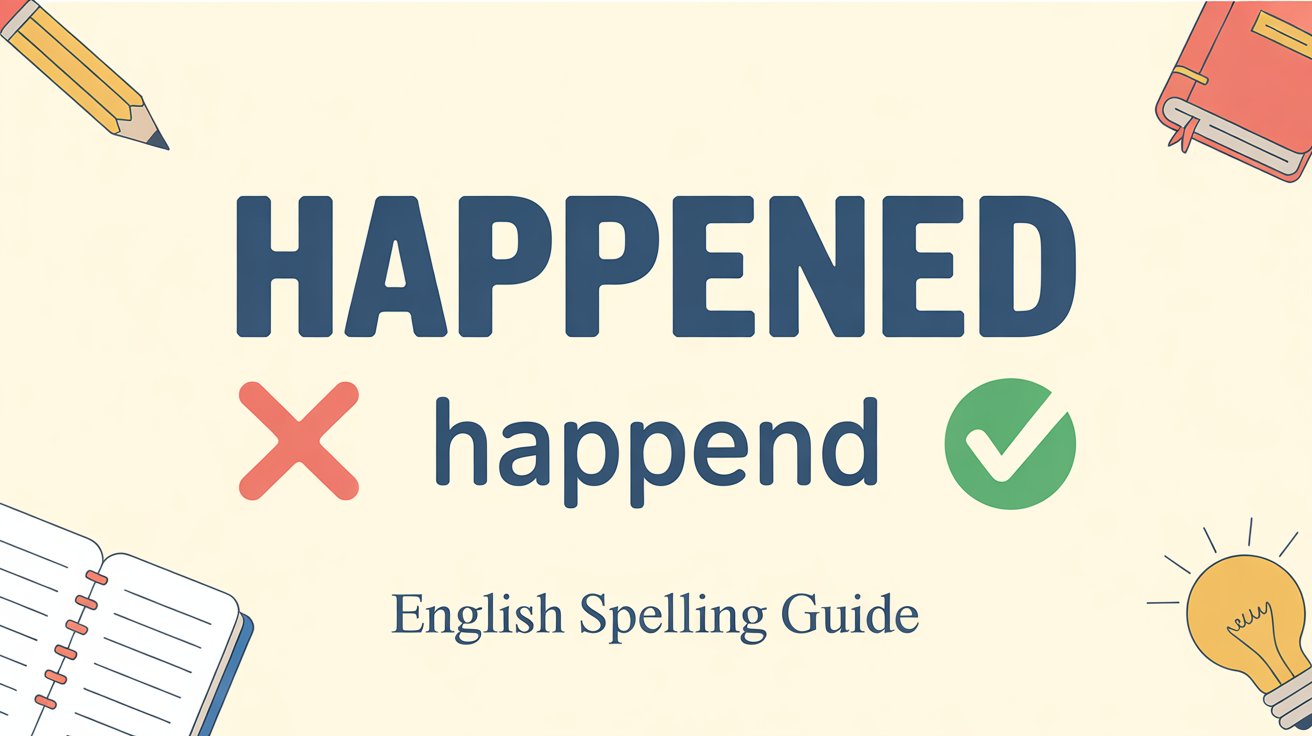
The term happened represents the past tense of happen. It describes an event that already occurred, something completed or finished in the past. English uses regular verbs like happen by attaching -ed at the end, which creates a consistent pattern for past-event narration.
The incorrect spelling happend and the even less common variation happends shows up because people type what they hear. Sound alone misleads writers, especially when the added -e- in happened doesn’t carry a strong pronunciation.
Common Misunderstandings
A few reasons explain the widespread confusion:
- Phonetic spelling errors encourage writers to drop the silent vowel.
- Misspelled English words gain traction through repetition in text messages or fast writing.
- Typographical error patterns emerge when someone types too quickly.
- Cognitive causes of spelling errors surface when your brain prioritizes speed over rule-based accuracy.
Once your mind associates the wrong version with the right sound, the mistake grows familiar. That familiarity makes happend vs happened feel like a genuine choice rather than a clear grammatical distinction.
How Do You Spell Happened?
Writers often search the exact phrases how to spell happend, how do you spell happend, or happend or happened, usually after spotting the misspelling in a draft. The answer remains simple:
You spell it happened, with the -en- carried through the final form of the past tense.
To reinforce the concept, think of related words:
- open → opened
- listen → listened
- happen → happened
Each keeps its internal vowel even when sounded softly.
The Correct Form: Happened
The version happened reflects standard English spelling rules and appears in every authoritative dictionary. Because writers rely on consistent patterns for proper verb conjugation, this spelling ensures grammatical accuracy and communication clarity in both informal and formal writing.
Using the wrong version distracts readers and undermines your credibility in academic, business, or professional environments.
Definition and Usage
Use happened to describe a completed event. You apply it when you point to a moment, an action, or an outcome that already took place. In narrative writing, the term anchors timelines. In conversation, it clarifies that you’re talking about the past rather than the present or future.
Sample definition:
Happenedverb, past tense of happen; used to indicate an event or situation that occurred or came to pass.
Grammatical Context
English organizes past events through regular verbs using -ed endings. Because happen qualifies as a regular verb, it follows the standard pattern. You don’t modify the root, rearrange letters, or replace vowels.
Writers often mix up regular and irregular verbs, which leads to common writing errors. Unlike irregular forms such as run → ran or go → went, the word happen stays structurally stable.
“How to Spell Happened”
When exploring how to spell happend, remember that English spelling patterns reward recognition rather than raw logic. You may not hear the extra -e-, but you need it to produce the correct past-tense form.
A reliable memory trick:
If the root verb ends in -en, the past tense keeps that spelling before adding -ed.
Why “Happend” and “Happends” Is Incorrect
The variant happend results from phonetic similarity, not from English spelling standards. Adding -d directly to the root breaks the rule governing regular verbs. Meanwhile, happends attempts to create a present-tense plural form that doesn’t exist in standard English.
Writers encounter these errors because they rely on pronunciation rather than rule-based spelling corrections. Once the incorrect form appears in muscle memory, it leads to repeated mistakes.
Spelling Rules in English
English doesn’t follow one universal rule, but it does offer clear guidelines for spelling rules for -ed endings:
- When a verb ends in -en, you add -ed without removing letters.
- When a verb ends in -e, you add -d instead of -ed.
- When a verb ends in a consonant preceded by a single vowel, you may need to double the final consonant (hop → hopped).
- Pronunciation does not always match spelling.
The word happen fits neatly into Rule 1.
Common Mistakes to Avoid
Writers most often struggle with:
- Dropping the -e- before adding -d.
- Replacing -ed with -d because of how the word sounds.
- Confusing similar past-tense verbs.
- Using incorrect forms in formal documents where accuracy matters.
Recognizing these grammar mistakes to avoid helps prevent larger errors in longer compositions.
“How to Spell Happend” Correctly
Someone asking how to spell happend usually wants reassurance, not a lecture. The simplest answer:
Spell it happened. The version without the -e- doesn’t appear in any reputable dictionary and doesn’t align with English grammar spelling rules.
Side-by-Side Comparison
A direct comparison reinforces the difference:
| Form | Status | Explanation |
|---|---|---|
| happened | Correct | Past tense of happen; standard English form. |
| happend | Incorrect | Misspelling based on phonetic similarity. |
| happends | Incorrect | Non-standard form; not used in English. |
Key Differences
A few distinctions stand out:
- Happened follows established patterns for correct past tense verbs.
- Happend breaks the spelling pattern altogether.
- One supports clear communication; the other creates confusion.
- One appears in trusted writing; the other surfaces only as an error.
Famous Quotes on “Happened”
Many memorable lines include the word happened, not because it stands out, but because it fits naturally into storytelling and reflection. Consider these examples:
- “What has happened once can happen again.”
- “Everything that has happened shapes what comes next.”
- “Nothing important ever happened without someone asking why.”
These examples show how writers use the term to narrate past events, express insight, or reflect on consequences.
Everyday Usage Examples

To understand how to use the term in conversations, consider ordinary sentences:
- “Something unexpected happened on the way to work.”
- “A mistake happened because the file wasn’t saved.”
- “That awkward moment happened before anyone noticed.”
These examples illustrate how to use happened in sentences without forcing the phrasing or structure.
Sample Sentences
The following scenarios demonstrate varied applications:
- “The meeting happened faster than anyone expected.”
- “An error happened when the system overloaded.”
- “A funny misunderstanding happened at dinner last night.”
- “What happened after the announcement surprised everyone.”
These sentences reinforce the event description in past tense and highlight the flexibility of the word.
Contextual Scenarios
Writers often struggle with contextual usage scenarios, so the examples below show how the correct spelling clarifies meaning:
Workplace Scenario
A team finishes a project, but one file disappears. A colleague asks, “Do you know what happened to it?” The spelling signals a past event that needs explanation.
Academic Scenario
A student summarizes a historical event: “The treaty happened at a pivotal moment.” The usage marks the event as complete and set in time.
Everyday Conversation
Someone recounts a mishap: “I don’t know what happened, but the lights went out all at once.” The word guides the listener through a simple narrative.
In each case, the correct spelling ensures clarity, precision, and trustworthiness.
Conclusion
Writers encounter countless frequently confused English words, but the pair happend or happened shouldn’t linger on that list. Only happened delivers the correct structure, the right meaning, and the expected form in English communication.
Whenever you ask how to spell happend, how do you spell happend, or notice the misspelling in your draft, rely on clear spelling rules instead of phonetic guesses. The more you reinforce the correct version, the faster your writing gains precision, confidence, and flow.
Accuracy in past-tense verbs shapes how readers interpret time, events, and meaning. When you select the right form, you strengthen every sentence that follows.
