

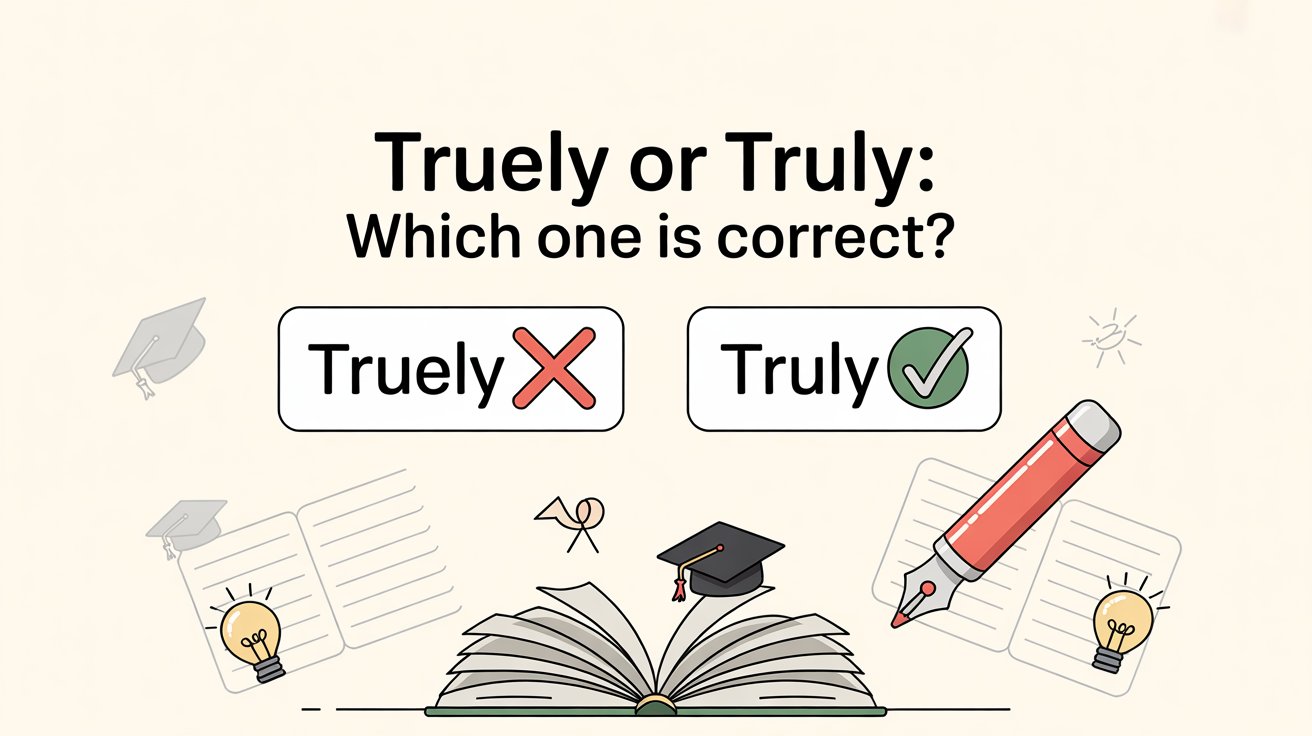
English can feel like a maze sometimes. Just when you think you’ve nailed the rules, a small word trips you up. One of the most common spelling mistakes in English shows up in everyday writing, emails, captions, and even professional documents: truly vs truely.
At first glance, both look reasonable. Both sound identical. And honestly, autocorrect doesn’t always save the day. So is it truly or truely? Which spelling is right, and why does the wrong one keep showing up everywhere?
Let’s clear the confusion once and for all. By the end of this guide, you’ll not only know the correct English spelling, but you’ll also understand the logic behind it, remember it easily, and never second-guess yourself again.
Quick Summary
- Truly is the only correct spelling
- Truely is a common misspelling
- The error happens because of overgeneralization of spelling rules
- English follows specific adverb formation rules
- Once you learn one simple trick, you’ll never misspell it again
Short answer? Use truly. Always.
Now let’s unpack the details.
Is It Truely or Truly?
This question pops up more often than you might expect. Students ask it. Professionals Google it. Native speakers hesitate over it.
So let’s be direct.
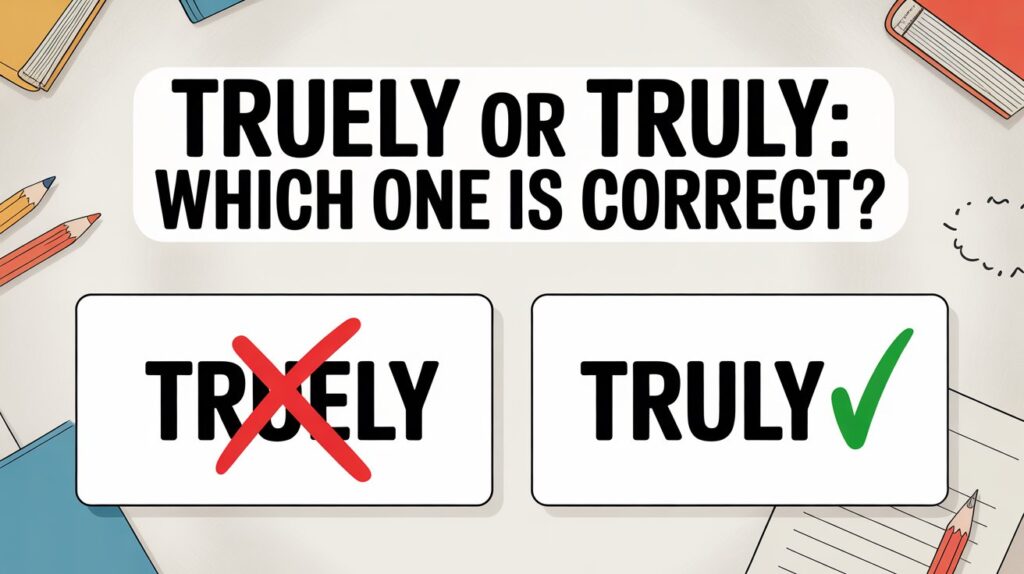
👉 The correct spelling is “truly.”
👉 “Truely” is incorrect in all standard forms of English.
There’s no situation formal or informal writing where truely spelling is acceptable. It doesn’t appear in dictionaries. It isn’t a regional variant. And it isn’t an old form that faded out.
It’s simply wrong.
Still, the mistake is understandable. English spelling loves to bend its own rules, and this word is a perfect example of English spelling confusion.
Understanding the Difference Between Truly or Truely
Here’s where things get interesting.
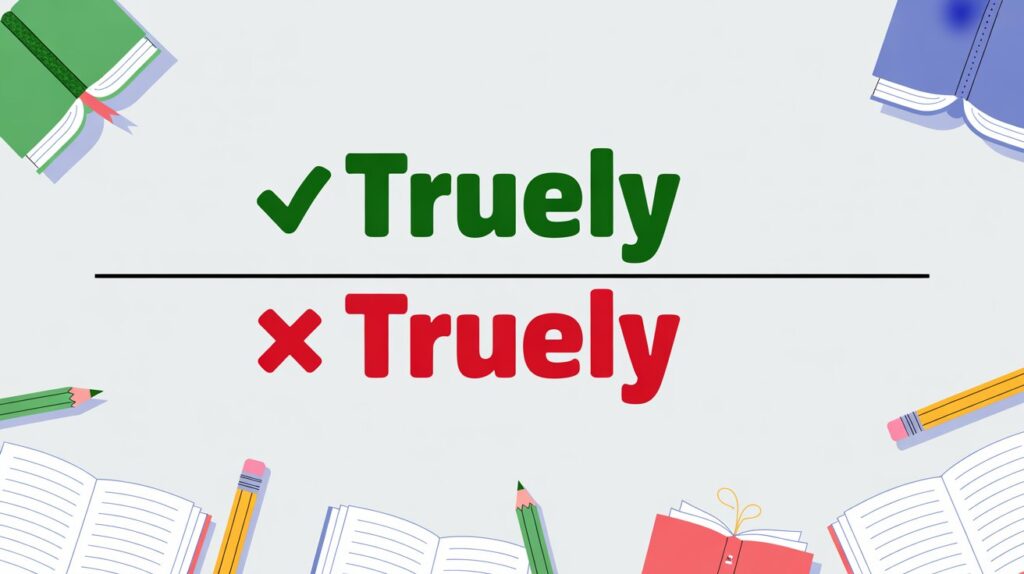
The confusion between truly vs truely comes from how English forms adverbs. Many adverbs end in -ly, which makes writers assume you just add ly to the base word without changes.
For example:
- Quick → quickly
- Honest → honestly
- Careful → carefully
So naturally, people think:
- True → truely
That feels logical. But English doesn’t always reward logic.
Truely: A Common Misspelling
Let’s talk about the problem child.
Truely is a textbook example of spelling errors in English caused by assumption. Writers apply a rule that works most of the time, only to discover this word refuses to cooperate.
You’ll often see truely incorrect spelling in:
- Social media posts
- Text messages
- Blog comments
- First drafts of essays
- Even business emails
It slips through because spellcheck doesn’t always flag it, especially in casual platforms.
But make no mistake. Truely is not a word in standard English.
Why Is “Truely” Incorrect?
The reason comes down to a specific rule in English grammar conventions.
The Rule That Matters
When forming adverbs from adjectives that end in -e, English often tells us to:
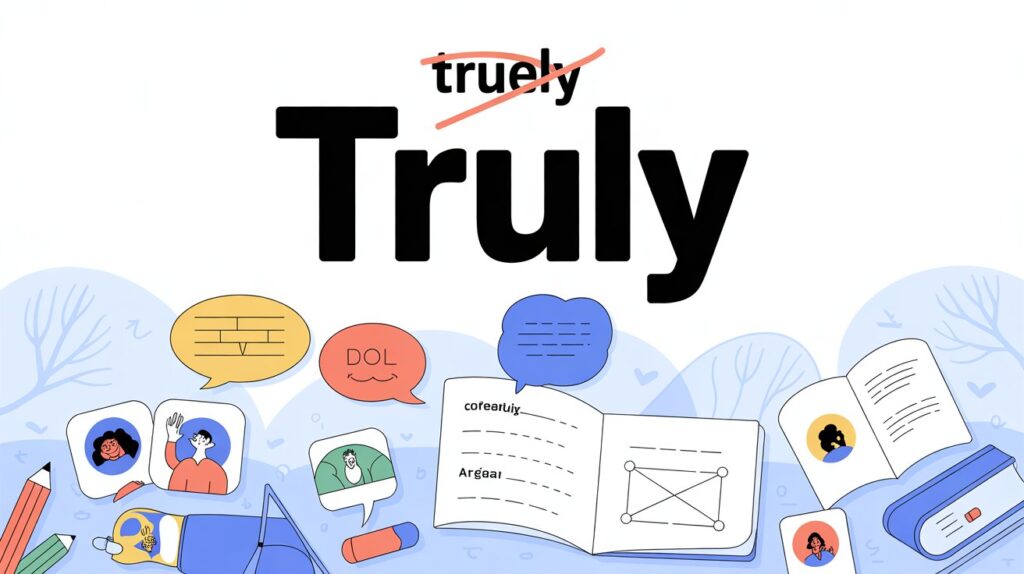
Drop the “e” before adding ly
So:
- True → truly
- Due → duly
- Whole → wholly
This rule overrides the instinct to simply tack on ly.
Many writers forget this rule, which leads to the overgeneralization of spelling rules. The brain says, “Just add ly,” and the fingers follow along.
That’s how truely spelling sneaks in.
Truly: The Correct Form
Now let’s give credit where it’s due.
Truly is the correct adverb form of true. It aligns with established adverb formation rules, appears in every major dictionary, and follows centuries-old spelling patterns.
Truly Meaning
Truly means:
- In a truthful way
- Genuinely
- Honestly
- Without exaggeration
It often emphasizes sincerity or accuracy.
Example:
“I truly appreciate your help.”
That one word adds warmth, honesty, and emphasis. It’s small, but powerful.
Key Facts About “Truly”:
- ✔ Accepted in all forms of formal and informal writing
- ✔ Follows historical English grammar conventions
- ✔ Used in professional, academic, and creative writing
- ✔ Pronounced the same as the incorrect version
- ✔ One of the commonly misspelled words in English
Knowing these facts boosts grammar accuracy and strengthens professional writing clarity.
Side-by-Side Comparison of Truely or Truly
| Aspect | Truly | Truely |
|---|---|---|
| Correct English spelling | ✅ Yes | ❌ No |
| Dictionary accepted | ✅ Yes | ❌ No |
| Professional writing | ✅ Appropriate | ❌ Incorrect |
| Common usage | Very common | Common mistake |
| Grammar accuracy | Correct | Incorrect |
If you’re ever unsure, this table is your quick gut check.
Everyday Usage Examples
Seeing words in context makes everything click. Let’s walk through real-life scenarios.
Scenario 1: A Thank-You Email
You’re writing to a colleague after a big project.
✅ “I truly enjoyed working with you.”
❌ “I truely enjoyed working with you.”
One version sounds polished. The other quietly undermines credibility.
Scenario 2: Social Media Caption
You’re sharing a meaningful moment.
✅ “I’m truly grateful for today.”
❌ “I’m truely grateful for today.”
Even casual writing benefits from correct spelling.
Scenario 3: Academic Writing
You’re emphasizing a point.
✅ “This result truly supports the hypothesis.”
❌ “This result truely supports the hypothesis.”
Academic readers notice these details.
Correct Examples
Here are more examples of truly usage in sentences:
- “She truly believed in the mission.”
- “That movie was truly unforgettable.”
- “I truly don’t understand the hype.”
- “He truly means what he says.”
Each sentence uses truly correct usage to add emphasis and sincerity.
Incorrect Examples
Now let’s see what not to do:
- ❌ “I truely don’t care.”
- ❌ “She was truely shocked.”
- ❌ “This is truely amazing.”
Every example above contains a truely incorrect spelling that weakens the writing.
Tricks to Remember the Correct Spelling
Memory tricks make all the difference.
Trick #1: Remember “Due → Duly”
If due becomes duly, then true becomes truly.
Trick #2: No Extra “E”
Say it out loud: true-ly, not true-e-ly.
That extra “e” doesn’t belong.
Trick #3: Think Minimal
English often removes letters when forming adverbs. Less is more.
These tricks help beginners and experienced writers alike.
Frequently Asked Questions
Why Do People Misspell “Truly vs Truely”?
Because English isn’t consistent. Many spelling mistakes native speakers make come from applying rules too broadly. Writers assume every adjective simply adds ly, forgetting exceptions like this one.
Do Both Have the Same Pronunciation?
Yes. The pronunciation of truly sounds identical to the incorrect version. That’s why spellcheck alone isn’t enough. You have to know the rule.
This is a classic case of English spelling confusion caused by sound-based spelling.
Can “Truely” Ever Be Considered Correct?
No.
If you’re wondering is truely ever correct, the answer is a firm no. It has never been accepted in standard English, historically or modern.
Quiz Yourself: Spot the Error
Let’s test your understanding.
Which sentence is correct?
- “I truely believe you.”
- “I truly believe you.”
Take a second. Trust your instincts.
Fill in the Blank with
Choose the correct option.
“She ___ understands the problem.”
- a) truely
- b) truly
Answers and Explanations
Correct answers:
- Sentence 2 is correct.
- Option b) truly is correct.
Why? Because truly spelling follows the rule to drop the “e” before adding ly.
Well done if you got it right.
Quick Tips Recap
- Truly is the correct spelling
- Truely is always wrong
- Drop the “e” before adding ly
- Same pronunciation, different correctness
- Proofread carefully for commonly misspelled words
These habits improve proofreading writing and overall confidence.
Conclusion: Truly or Truely
Let’s wrap it up clearly and confidently.
When choosing between truly or truely which is correct, there’s no debate. Truly wins every time.
This tiny spelling choice carries more weight than it seems. It affects professional writing clarity, signals attention to detail, and reflects strong command of English grammar conventions.
English has a long, winding history shaped by Old English word origins and centuries of change. Along the way, it picked up quirks like this one. Learning them isn’t about memorization. It’s about pattern recognition.
So next time you pause and wonder is it truly or truely, trust yourself. Drop the extra “e.” Keep it clean. Keep it correct.
